
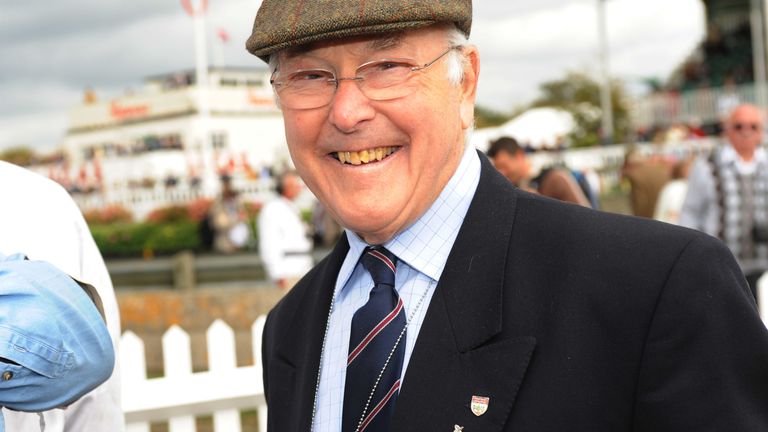

In The Eternal Racing Tracks, we remember drivers and paddock figures who have made a significant impact on motorsport and its rules and regulations. Part 6 is dedicated to the voice of F1, Graeme Murray Walker OBE, who passed away aged 97 following a short illness. Whilst Murray might not have made an impact on the sport’s rules and regulations, he became synonymous with F1 through his commentary.
Commentating Style:
To this day, Murray is considered to be the voice of F1 by many fans. Not only did several generations grow up hearing his commentary whilst watching races, his passion for the sport in turn ignited that same passion in others. What helped him convey his passion was the delivery of his words, Murray commentated standing up rather than sat down, allowing him to speak louder due to his lungs being inflated and his shoulders pushed back.
Back in 2014, Stephen Moss from the Guardian aptly labelled Murray’s commentating style as “the fan who happened to have been given the keys to the commentary box: he couldn’t control his enthusiasm and that seemed naturally to lead to catastrophe.” Drivers on the grid share this sentiment, when reigning world champion Lewis Hamilton paid tribute to Walker, he said;
“So sad to hear of Murray’s passing. I remember growing up hearing your voice over the races. You made the sport so much more exciting and captivating. The iconic voice of our sport and a great man, thank you for all you did, you will never be forgotten. Rest in peace.”
It wasn’t just his passion for the sport which appealed to people, his encyclopaedic knowledge of racing kept fans engaged when on-track events were less spectacular to watch. Walker prepared himself for every race by meticulously researching facts and statistics on every driver and racetrack, updating and rewriting his notes for the following Grand Prix. He was also a good reader of mood after an on-track incident and uncritical of drivers who had made errors, preferring to let that judgement pass to his co-commentators. Murray also held enough authority amongst the press that members of the Formula One community would rarely decline to be interviewed by him.
What made him more approachable was the fact that despite his passion and knowledge, his commentating style wasn’t perfect. His comical blunders during live races were often dubbed “Murrayisms” by fans, famously stating “This is fantastic” following a collision between 1989 Championship protagonists and teammate, Ayrton Senna and Alain Prost, at the Japanese Grand Prix. It is then no surprise that Murray Walker was voted to be “the greatest sports commentator of all time” in a poll conducted by British sports fans in late 2009.

Career:
Walker, a WWII veteran, began his career as a commentator in 1948 at the Shelsley Walsh Hill Climb. After covering several car and motorsport events at the BBC for both radio and television, he commentated on the Isle of Man TT with his father Graham. In 1962, Murray Walker became the main motorsport commentator for the British broadcaster. In the 1970s, he occasionally took on the Formula 1 commentary only to become the permanent F1 commentator from 1978 onwards.
His co-commentators include the late James Hunt, who was F1 world champion in 1976, and the pair built up a memorable partnership. Walker would provide his animated descriptions of the action whilst Hunt brought in his expert knowledge. Initially they did not get on, as Hunt’s interests, personality and private life appeared to have little in common with Walker’s. However, the pair eventually became good friends. Walker and Hunt were to work together for more than a decade at the BBC, until Hunt’s death from a heart attack two days after the 1993 Canadian Grand Prix, aged 45.
There were a few other co-commentators with Walker until the beginning of 1997, when Martin Brundle joined him in the booth. The partnership between the two of them proved to be quite popular and is remembered fondly by Martin;
“Wonderful man in every respect, […he is a…] national treasure, communication genius […and…] Formula 1 legend.”
At the 2000 German Grand Prix, Walker incorrectly stated that Ferrari driver Rubens Barrichello had crashed when in actuality it was his teammate Michael Schumacher. This led to criticism about his frequent errors and it prompted Walker to speak to his bosses at ITV Sport about his future. Murray informed Brian Barwick, the broadcaster’s head of sport, that he would retire. The 2001 US Grand Prix was the last Formula 1 race he commented on after which he was awarded an original brick from “The Brickyard” by track president Tony George, a honour very rarely bestowed on anyone other than the winning driver of a major race at the venue.
Legacy:
Murray Walker commentated almost 500 Formula 1 races in his time as commentator, add to that thousands of other races in other Motorsport series and it is no surprise that the name Murray Walker is synonymous with motorsport.
Not only did Murray commentate on a plethora of events, his knowledge and passion served as an example for others too. Eddie Jordan, former team owner and BBC F1 chief analyst stated; “He was so well prepared. He was very nonchalant about it, he didn’t give that impression but he had the knowledge.” It is then no surprise that many of the current commentators from across the world have sought advice from Murray Walker about their commentary styles or the inner workings of the F1 paddock.
His presence will be sorely missed, but as James Allen – the commentator who succeeded Walker in ITV’s commentary booth – said; “He had a life incredibly well lived.”


