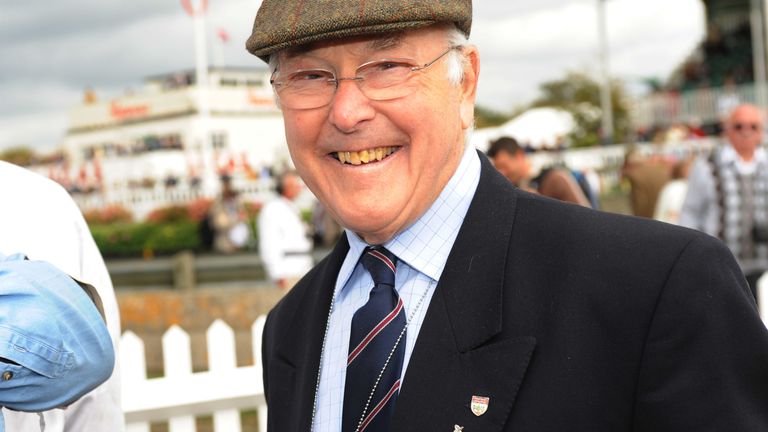
In The Eternal Racing Tracks, we remember drivers and paddock figures who have made a significant impact on motorsport and their rules and regulations. Today we remember Sir Francis Owen Garbett Williams CBE (16th April 1942 – 28th November 2021), who passed away after a short illness. Frank was the founder and former owner of the Williams Racing, one of the last privateer teams in Formula 1 that celebrated much success across the 1980s and 1990s.
“Very sad news. Sir Frank Williams leaves a lasting impression on the history of @F1. He was a pioneer, an exceptional personality & an exemplary man. On behalf of the entire @FIA Community, our thoughts are with his family, friends & @WilliamsRacing. Rest in peace, my friend.”
Jean Todt, President of the FIA (via Twitter)
The team founder’s path to the sport began after he was bitten by the motorsport bug at school and hitchhiked his way to the 1958 British Grand Prix. Frank Williams would ironically meet Jonathan Williams after crashing an Austin A35 in a race at Mallory Park. The pair struck up a conversation, quickly became friends, and Williams’ namesake later introduced him to one of his future drivers, Piers Courage.
Williams scraped by in the early sixties as a combination of driver and mechanic, though the zest for speed meant he often inflicted an expensive toll on his machinery. By the second half of the 1960s he was doing better business buying and selling parts than competing, so driving increasingly took a back seat.
By 1968 Frank Williams Racing Ltd had expanded from a series of lock-ups to dedicated premises in Slough. Having successfully run a Formula 3 car for Piers Courage as a one-off, Williams entered him in the first of a series of Formula 2 races that year in a Brabham.
They stepped up to F1 the following year with a Brabham BT26 chassis. After a few unsuccessful non-championship outings and a retirement on their World Championship debut at Montjuïc Park, Barcelona, Courage brought the team’s first F1 podium with a classy drive to second place in Monaco. He repeated the result later in the year at Watkins Glen and subsequently enjoyed more success in their F2 outings.
Tragedy struck in 1970, as Piers was killed in a fiery crash on lap 23 of the Dutch Grand Prix at Zandvoort. Williams admitted he was “heartbroken” by the death of a friend and driver he “worshipped”. Nonetheless he ploughed on after the tragedy, though the years which followed were arduous, filled with false starts, mounting debts and frustrations as a succession of chassis projects failed to get off the ground.
Despite Jacques Laffite delivering a timely return to the podium at the Nürburgring Nordschleife in 1975, Williams’ financial woes were becoming increasingly serious, and he sold 60% of the team to Walter Wolf in order to settle its debts. However, after an unhappy 1976 in which he felt increasingly side-lined, Williams and his new hire – designer Patrick Head – sold the rest of his team and started from scratch again. His new team was called Williams Grand Prix Engineering.

A March was entered for Belgian pay-driver Patrick Neve throughout 1977, but for 1978 the team produced its own car, designed by Head. They showed potential from the get-go, Alan Jones qualifying 14th for the season-opener and eighth at the second round. At the third race in Kyalami he raced to an impressive 4th from 18th on the grid. Earning second at Watkins Glen underlined their potential.
The team’s first win came when Clay Regazzoni drove the Cosworth-powered Williams FW07 to victory at the 1979 British Grand Prix at Silverstone. Their first Drivers’ and Constructors’ Championship both came in 1980, with Jones winning the drivers’ title. Between 1981 and 1990, the team won two more Drivers’ Championships and three more Constructors’ Championships.
Despite overseeing the team’s successes, Frank’s life changed dramatically on the 8th March 1986 when a car accident on a trip between Paul Ricard and Nice Côte d’Azur Airport rendered him tetraplegic. He would require life-saving surgery after being repatriated back to the Royal London Hospital in England by wife Virginia, and would be physically reliant for the rest of his life.

Frank wouldn’t let being wheelchair bound affect him though, as he returned to the trackside in 1987. It was in 1992 where the team reached stunning levels of dominance with the active suspension FW14B. That car and its successor, the FW15C, were technological leaps beyond what the opposition had devised, regularly whole seconds per lap faster than anything else.
Mansell won the 1992 title at a canter, yet in bizarre circumstances both he and teammate Riccardo Patrese were gone at the end of the season, Williams having balked at the British star’s demands. Therefore, Prost stepped into the Williams for 1993 and took his final title, accompanied by Damon Hill.
For 1994 Senna replaced Prost, but Williams faced a new threat as much of the technology they had perfected in previous seasons was suddenly outlawed. The introduction of in-race refuelling introduced a new tactical variable they were slow to master. Then at Imola came a deep shock to the team and the motorsport world: Senna speared off the track while leading the San Marino Grand Prix and was killed.
The team would be dragged through a number of trials and lawsuits related to the crash, which would eventually be settled in 2005. To this day the team has ran with a Senna logo on every car since the tragedy.
Despite this devastating loss of such a talented driver, they added another Constructors’ title in 1994, though Hill missed out on the Drivers’ title following a controversial collision with Michael Schumacher at Adelaide. In 1996 whilst on his way to the title, Hill like Mansell before him, discovered Williams’ unsentimental side, as he was shown the door.
“We have lost a true hero of our sport and an inspiration for so many beyond it. Sir Frank not only created a special F1 legacy but showed the power of human determination to overcome huge adversity. Thoughts with his family and the Williams team.”
Zak Brown, McLaren CEO
The 1997 season saw the most recent championship success for Williams to date. Jacques Villeneuve resisted a late attack from Schumacher to clinch the crown. The early 2000s were dominated by Ferrari, but Williams gave it their best shot and charismatic driver Juan-Pablo Montoya was an early title contender in 2003 before controversial tyre changes swung the momentum to the Scuderia.
As the team faded from their glory days, they nonetheless ushered several major names into the sport. Including Nico Rosberg, Valtteri Bottas and, latterly, George Russell, who will join Mercedes for 2022. Though it is the infamous Pastor Maldonado, who may not feature in this list of major names, who was the last driver to score a victory for Williams at the 2012 Spanish Grand Prix.
The same year saw Frank step-aside from the day-to-day control of his team, handing the reigns over to his daughter, Claire. Just a year later, more tragedy would hit the family as Frank’s beloved wife, Virginia, passed away after a three-year long battle with cancer. Virginia helped finance Frank’s early forays into motor racing and wrote an account of the aftermath of the crash which paralysed him in her 1991 book A Different Kind of Life, although Frank chose to not read the book in order to leave the past in the past.
After a testing 2013 season, the team bounced back at the start of the hybrid era as the team, comprising of Bottas and Felipe Massa, regularly challenged for podiums. They even took a pole position at the 2014 Austrian Grand Prix courtesy of Massa. Williams also achieved the record for most points scored in an F1 weekend as the team finished P2 and P3 at the season ending Abu Dhabi Grand Prix, taking a haul of 66 points thanks to the double-points cameo.
“Sir Frank Williams was one of the kindest people I had the pleasure of meeting in this sport. What he achieved is something truly special. Until his last days I know he remained a racer and a fighter at heart. His legacy will live on forever.”
Lewis Hamilton, Mercedes AMG Petronas F1 Team driver
2015 and 2016 brought some further podium finishes, the high being Massa leading the early stages of the 2015 British Grand Prix. However, the team spiralled back down in the grid between 2017-2019, as Williams barely scraped into the points. Facing growing financial challenges amplified by the 2020 pandemic, the team was sold to current owners Dorilton Capital early last year.
Its new owners wisely chose to leave in place the iconic name after taking control of the team ahead of the 2020 Italian Grand Prix. A name which, to F1 fans of the eighties and nineties, was associated with some of the most successful and dominant cars the sport as ever seen. Even as a fan from the 2000’s, it still felt like the F1 tapestry was being ripped up when the Williams family exited the sport. To have the name live on (for now) is a nod towards the mark Williams left on the sport.

After suffering spates of ill-health in recent years, Sir Frank Williams passed away on 28th November 2021 and is survived by his children Jonathan, Claire and Jamie.
“Frank’s commitment and enthusiasm towards success on the track was infectious, not only to me but to all others who worked at Williams. Right up to the final days of the Williams family running the company, Frank could be seen in the factory and particularly in the ‘Race Shop’ with the cars and the team mechanics, inspiring his workforce.”
Sir Patrick Head, former aide at Williams F1 team
Sir Frank will be sorely missed, a titan of the F1 paddock for over five decades, his spirit and determination drove his team to a number of successes. This weekend’s Saudi Arabian Grand Prix will be one of reflection to a true gentleman of the sport.