
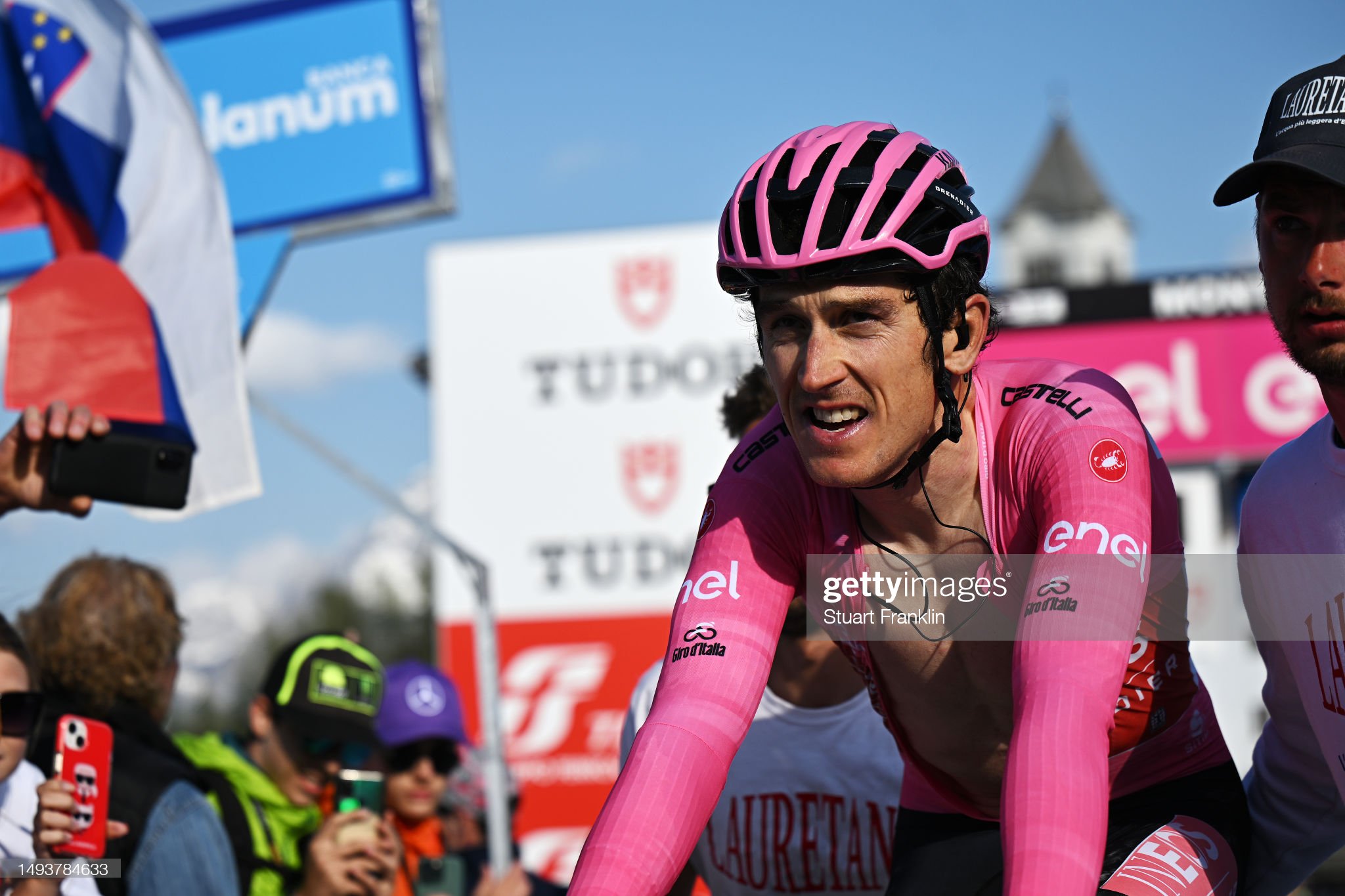
Second can be one of the cruellest places to finish in a bike race. Good enough to have won in slightly different circumstances but not good enough this time. This Giro produced high quality racing and a slow-burn storyline that allowed sub-plots to flourish whilst team leaders did all they could to keep their powder dry until the final week where the race was at its most decisive.
The race’s focal point was the Mountain Time Trial (MTT) up Monte Lussari and as that was the penultimate stage and the last meaningful stage for the overall race, anything that preceded was merely an act of positioning oneself as well as possible and gaining small advantages over rivals. This led to a fair few breakaways being successful whilst the riders contesting overall victory knew that those days weren’t their time.
The last time Primož Roglic was in a Grand Tour that had a MTT on the penultimate day was that fateful occurrence in 2020 where he was leading the race into that stage and presumed safe. He lost over a minute that day and with it the race to compatriot Tadej Pogačar. Fans were understandably worried about parallels being followed this time and those fears were not helped by a mechanical incident when Primož was in the ascendancy.
Thankfully, for him, he was able to regain his momentum and beat Geraint Thomas (G) by enough time to take the lead and the overall victory. That previous second place exorcised and consigned to deep history.
Second place can act as fuel or it can drive a person to despair, generating self-reflection of “what did I do wrong?”, “why wasn’t I good enough?”, “will I ever be good enough?”. Some say it has a galvanising quality for younger riders, it increases their hunger for victory by the delaying of their gratification. G is 37 now and it’s unlikely that he’ll have many more chances at this level. However, as he says, coming second is something he’s proud of and now he’s going to “let his hair down” or words to that effect, now the race is done.
In a race that’s so often defined and decided by seconds, it really was defined by seconds. Geraint finished second overall, but having led into the final meaningful stage that is understandably devastating. The mark of a true champion isn’t in the winning, it’s how they react to losing. It would have been easy for him to wallow in self-pity; or just cruise in the bunch on the processional final stage in Rome – the eternal city.
That’s not the man that he is. Instead of that, after being kept safe by his team, he spotted a friend in need- not even from his team- and so he rode at the front of the bunch to keep Mark Cavendish well-positioned for the sprint. He absolutely did not need to do that. Online forums would not have been criticising him for a perceived lack of work. And yet, that’s what he chose to do, to give his energy to the benefit of a friend who’s retiring at the end of the year.
In any other year, coming second overall and second on three individual stages would be quite remarkable. This year is unlike any other. Derek Gee, the second of the Gs, had quite the run of results.
He’s at the other end of his career compared to Thomas- where Thomas is 37, Gee is 25 and relatively new to the road scene. He’ll have more opportunities, other chances to come back stronger and get a precious victory. He got four second places in individual stages, the first was remarkable and represented a step up and something to be proud of. By the fourth one it was heartbreaking – he attacked on the final climb and was leading, heading to victory, right until getting caught and surpassed by Santiago Buitrago. If second place is to have a galvanising effect, Gee must have thought “ok Giro, you can stop now, I’m galvanised quite enough now”.
And yet, including all classifications of the Giro, Derek Gee got eight different second places, four in stages, a second place in the mountain classification, second place in the points competition, another in the “most kilometres in a breakaway” competition and finally, the one prize he was leading was taken away from him by Toms Skuijins winning the Intermediate Sprints competition with a move on the last day. He even came 22nd overall- perhaps second there would have been too on-the-nose.
In cycling history, there was Raymond Poulidor who had a moniker of “the eternal second” for the fact he came second in the Tour de France three times. Jan Ullrich had also been given the German version of that nickname “der ewige Zweite”, on account of losing out to Lance Armstrong so many times. Perhaps now, in the Eternal City of Rome, we have found this generation’s “eterno secondo” of Derek Gee. Thankfully, he did win the combativity prize for the most attacking rider of the race, and along with it the hearts of many fans. I’ll leave you with this, he wasn’t the only rider to come second in four individual stages- Jonathan Milan also achieved this feat and it’s only fitting that Gee was the second to do so.
Featured image courtesy of Stuart Franklin via Getty Images


