FEATURED IMAGE CREDIT: DAVID STOCKMAN/GETTYIMAGES
In women’s cycling so far this season, one-super team has been Trek-Segafredo due to their performances.
Australian rider Amanda Spratt is the best example of someone who is performing incredibly well – a podium placing at her native National Championships, followed by a podium and the mountains jersey at the Tour Down Under, another podium at the Cadel Evans Great Ocean Road Race followed by one more podium in Europe at the Setmana Ciclista Valenciana.
Trek’s accomplishments are not just one solo effort though as Italian pair Elisa Longo Borghini and Gaia Realini finished first and second overall at the inaugural UAE Tour Women – no surprise then that Spratt, Longo Borghini and Realini are top-four at the time of writing with Trek dominating in the UCI team standings.
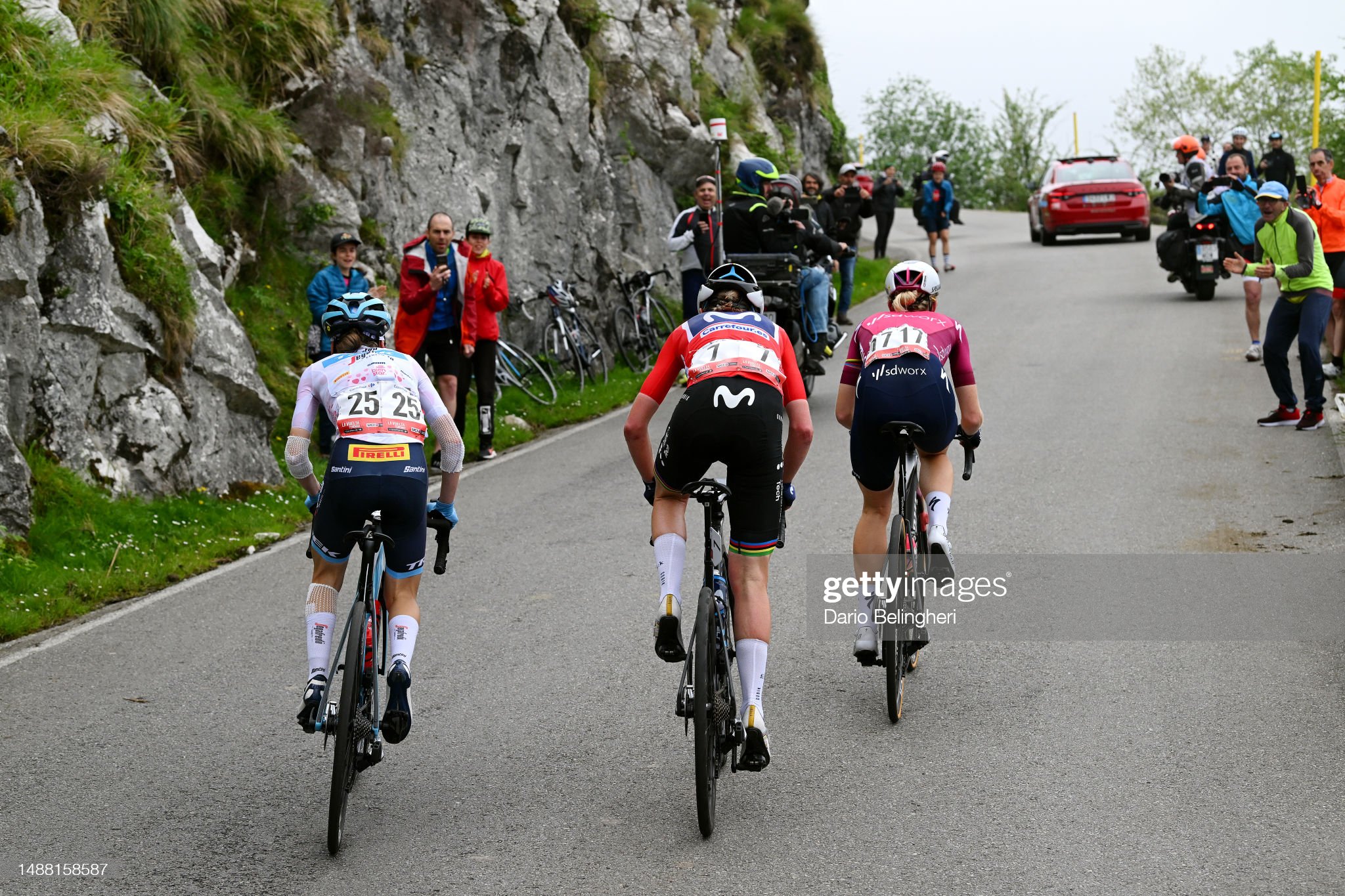
The only rider who breaks up this Trek-Segafredo hegemony is Dutch rider Floortje Mackaij from the Movistar team as a result of her performances in Spain, which has included a win in the Vuelta CV Femeninas, a podium at Clasica de Almeria and a top-10 at the Setmana Ciclista Valenciana.
In comparison to the riders and teams leading the way in early-form stakes, Team SD Worx have been largely anonymous. Admittedly they have only taken part at the UAE Tour Women and did not participate in any of the Australian or European UCI races to date -another Dutch rider in Lorena Wiebes is the one SD Worx rider who has bagged herself a perfect set of top-three placings in the sprint stages, as well as a second place on stage one with a win on stage two and a third place on the race’s final day. So going into the weekend they were rather an unknown quantity.
Statistics only tell half a story as we can see, but historically SD Worx have been accused of having too many options. In fact many race previews about Omloop this weekend cited the team’s embarrassment of riches when it comes to talented riders but their lack of cohesion on the road. Their riches have only increased in the off-season when you consider they’ve added Lorena Wiebes, another Dutch star in Mischa Bredewold and others to their ranks.
However, personal ambition can lead to discordance and it would be entirely understandable that in a team full of potential race winners, if all of them felt that they should be the one that gets the opportunity this time.
Due to this reputation of having “too many cooks”, I think it deserves some focus on it from myself and my It’s All Sport To Me colleague Lena alongside me casting her eye. Looking at how the SD Worx team raced on Saturday, means I want to delve further here. In their selection for the race, all their riders were ones that if you told me on Sunday morning that they had won; we wouldn’t be surprised in the slightest. There aren’t many other teams you can say that about.
When the coverage -finally- commenced with 27km left to race, Arlenis Sierra – the Cuban rider from Movistar – was ahead solo. This seemed like a mistake from SD Worx, to allow a strong opponent to be alone, to be a potential winner or at the very least a satellite rider that one of their leaders could bridge to and benefit from. However, I’m beginning to see it as a calculated risk. One rider alone would tire making an effort for over 30 minutes ahead of a peloton of reasonably fresh riders.
If you could turn the tables and link up with a rider from a rival team, then yours and their teams aren’t going to do any of the chasing work behind. Using simple probabilities it’s self-evident that it is much easier to win from a one-on-one scenario than winning from a group of 20. If you limit the variables the end result becomes more straightforward.
Arlenis Sierra led all the way to Gerardsbergen and the famous Muur, which everyone else was waiting for before making their first moves towards victory. The one rider who took advantage of the Muur was Lotte Kopecky (of SD Worx), who dropped everyone else and made her capabilities on cobbles known in the most emphatic way. She successfully limited her competition at that stage to the rider she was bridging up to. The above theory in play, it also stopped Movistar from chasing and it was indeed FDJ Suez who commenced the pursuit of the leading duo.
The duo had started by working together but in the lead-in to the Bosberg climb, Arlenis told Lotte that she wouldn’t be contributing to the pace-making – a sensible decision in the circumstances and one I would have made too – but that did mean that Lotte repeated her earlier feat to extricate herself from Sierra and proceed to the finish solo, the chase unable to reel her in and arguably had Movistar done the unthinkable and chased their own rider things might have been closer but that wouldn’t have been in their interests so it is rather a moot point but a well worked race from a tactical perspective from SD Worx.
Last year it was Annemiek van Vleuten (Movistar) and Demi Vollering (SD Worx) who headed to the finish in Ninove together; with the current world champion taking the victory on that occasion. Kopecky was SD Worx’s next best finisher in the bunch and is typically one of their better sprinters in classics-style races, so would have been the justification for Demi to not work with Annemiek and force her hand – albeit unsuccessfully.
We can only speculate what would have happened this year had van Vleuten not had to make an inopportune bike change on the run-in to Gerardsbergen, but I suspect had Annemiek been able to stick with Lotte then we would have seen a repetition of last year’s scenario, just with Lotte up ahead – who outsprinted van Vleuten at last year’s Strade Bianche – and an even better sprinter than her in Lorena Wiebes, able to sit in the bunch ready for a sprint should her team mate get brought back.
It is far too early in the season to make such a bold proclamation but I truly feel that Lorena Wiebes is the missing ingredient for SD Worx in this type of race. She adds an extra level to the team and a very real threat for other teams to worry about. She won the bunch sprint which psychologically gives SD Worx a distinct advantage over their rivals.
It is a terrifying proposition to think that as a team you can either try and bring the solo rider back to then be outsprinted at the finish, or you can leave the solo rider and not win that way. It’s like a “choose your own adventure” story but the only choices are how you are going to lose.
Teams won’t always get things right 100% tactically, it’s a statistical impossibility, however this race felt like SD Worx have started playing all the right notes in the right order. They created a situation for the other teams where they will feel that they are damned if they do and damned if they don’t. If they can continue to use their team in a similar manner in other races then it’s safe to say that they’ll be able to shake this reputation of them being a team that is talent rich but tactically poor.
SD Worx – can they SD Worx? If Omloop Het Nieuwsblad is anything to go by, then absolutely.
As an addendum, I think it’s great that Flanders Classics are paying women’s rider equal prize money to the men’s race and I hope they’re not the last race organisation to do so. However, the amount of TV coverage left a lot to be desired. Cobbled races especially are exciting due to their unpredictability – sure there are the “set pieces” such as the Muur van Gerardsbergen or the Paterberg that most riders wait for but those aren’t the only opportunities to attack and as we saw with the inaugural women’s Paris-Roubaix, the winning move can be made at any point.
Why then are we only getting to see 27km of racing in the women’s race?