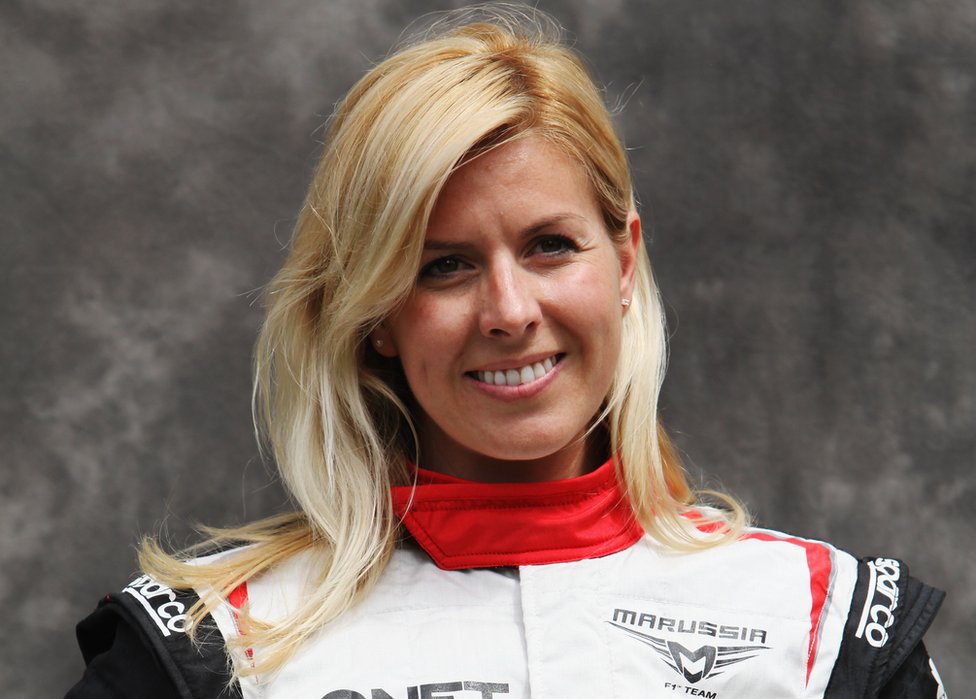

In the Eternal Racing tracks series we remember drivers who have made a significant impact on motorsport and their rules and regulations. Today we remember María de Villota.
As the daughter to former Formula One driver, Emilio de Villota, María had made sporadic appearances in a number of racing series, including Spanish Formula 3 and the World Touring Car Championship (WTCC) early on in her racing career. She also was the first person to coach Ferrari’s new recruit, Carlos Sainz Jr., during his transition from karting to single-seaters at Madrid’s Drivers’ School at the age of 13.
On the 18th August 2011, María made her F1 testing debut with the Lotus Renault GP team (now Alpine) in a Renault R29 at the Paul Ricard Circuit in France. With her management team publicly expressing her desire to secure a test driver seat in the future, the Spanish driver announced on 7th March 2012 that she had joined the now-defunct Marussia F1 team as a test driver.
María had her first experience in the Marussia F1 car on the 3rd July 2012, just five days before the British Grand Prix occurred, with a straight-line test at the Duxford Aerodrome in Cambridgeshire.
After a second successful run, María was returning to the service area when she collided with the tail lift of a trailer at approximately 35 miles per hour after the car failed to halt prior to the incident.
The impact caused life-changing injuries for María, who underwent a number of cranial and facial surgeries following the collision with the truck. Whilst escaping severe neurological damage resulting from the crash, team principal John Booth announced that María had lost her right eye and remained in critical condition in hospital.

María spent 17 days in the hospital before returning home to Spain, making her first public appearance in October 2012, revealing she had lost her sense of smell and taste, and suffered from regular headaches as a legacy of the crash.
In spite of the traumatic injuries, María was motivated to assist safety in motorsport and launched the First Star project to assist children with neurological conditions in Spain to receive physiotherapy and equipment to assist their quality of life.
Tragically, María was found unresponsive in a hotel room in Seville on 11th October 2013, just a day before the release of her autobiography; La vida es un regalo (Life Is a Gift). The de Villota family announced the 33-year-old had passed away due to a cardiac arrest resulted from a brain haemorrhage which had been linked to the testing accident in 2012.
A Health and Safety Executive (HSE) report into the accident, released on June 29th 2015, noted a number of issues relating to the accident, including difficulties in operating the clutch whilst steering was on full-lock. It also noted the fact that María had not been given notes on how to stop the vehicle by her race engineer.
The truck used by the team was also mentioned, where a standard trailer – rather than the usual race trailer – was used, and it had an “unusual” and “larger” tail-lift. The tail-lift was also left in a protruding position, unfortunately at eye level for a driver in the cockpit of an F1 car.
The de Villota family settled a lawsuit out of court with the Manor F1 team, which resurrected the team following the collapse of Marussia into administration near the end of the 2014 season. This was a particularly dark period for the Marussia F1 team that culminated in the devastating loss of Jules Bianchi in July 2015. It is imperative to remember that María also tragically lost her life too.
The incident may not have occurred on the track, but it raised important health and safety issues that arguably should have prevented Jules’ incident in the first place, because of the dangers of having stationary vehicles in the vicinity of moving Formula 1 cars.
Even a collision with a truck at a relatively low speed still had devastating consequences for María and her family, which re-emphasised the avoidable events at the Japanese Grand Prix just over a year after María’s passing.
In tribute, the Legado María de Villota (María de Villota’s Legacy) was launched in 2014 to continue her charitable work and has a number of high-profile ambassadors from the world of motorsport, including Sainz Jr. and Pedro de la Rosa. The Circuito del Jarama, near her birth city of Madrid, renamed the final corner to Curva María de Villota on 5th July 2015. The circuit, which formerly held F1 races between 1969 and 1981, organised foot races on Christmas Eve as a fundraising event in her name.