
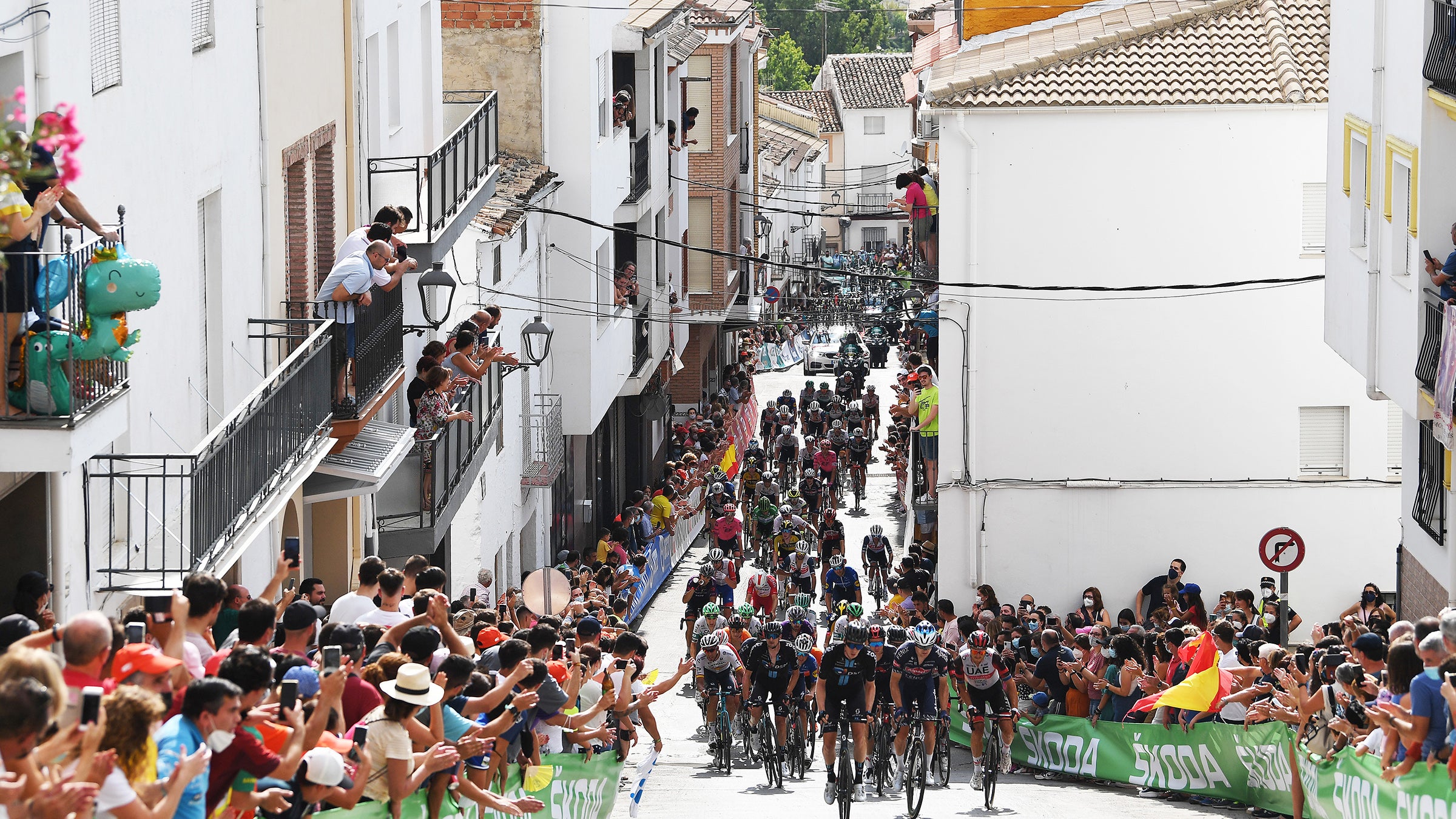
Featured image courtesy of VeloNews
It’s the final grand tour of the year, a 76th edition of the Vuelta in Europe’s most mountainous country. Week two is done, so what does week three have in store? From Burgos to Santiago de Compostela, the entire route is 3,417 km in total and already after 15 stages, the Vuelta now has 955.6 km remaining. With the entire route bookended by two time trials, the Stage 1 TT in Burgos has set the standard, in week two we’ve seen breakaways succeed and the GC hot up. That shouldn’t change in week three especially as every contender will fight for seconds before the final time trial on Stage 21. It’s worth a reminder that for the first time since 2014, this year’s race does not finish with the traditional sprint in Madrid.
Entirely within Spain due to COVID-19, here is a reminder of the overall route map.

Tuesday 31st August: Stage 16 Laredo to Santa Cruz de Bezana (Flat)
At 180 km this another flat stage which is incredibly unusual for a Vuelta. Stage 16 isn’t entirely flat but the climbs are not hard enough to deter the fast men.
Laredo at the start is known for it’s vast beach but the riders won’t be stopping long. They do follow the Basque coastline for a while and after 70 km the route turns inland.
The Alto de Hijas at 4.2 km long with slopes at 6.5% is the first climb of the day before the Alto de San Cipriano at 5.5 km in length averaging a 4.4% gradient is actually uncategorised but shouldn’t create too much trouble.
The final 50 km are undulating but a flat finish should ensure a sprint between Fabio Jakobsen who has two wins and Jasper Philipsen who also has two. Both the Dutchman and the Belgian have been dominant between them, but who will get the better here?

Wednesday 1st September: Stage 17 Unquera to Lagos de Covadonga (Summit Finish)
Stage 17 is without a doubt the showpiece occasion for this Vuelta. 185.8 km long, it looks straightforward as the four climbs in total are spread pretty evenly across the stage. The Alto de Ortiguero is taken on first before a double ascent of La Collada Llomena. A 7.6 km long climb with an average of 9.3%, one tough section features a tough 11% gradient too.
The scenery will be something to behold but the pain in the legs for all the riders won’t. The 12.5 km long climb to Lagos de Covadonga is iconic vintage Vuelta, featured for the very first time a long way back in 1983. Marino Lejarreta, Pedro Delgado, Laurent Jalabert, Luis Herrera and Nairo Quintana have all won here as has Frenchman Thibaut Pinot three years ago. Beautiful slopes in the Picos de Europa mountain range in Asturias, this Vuelta stage cannot be missed.
Other GC contenders will really want to take this stage. A Primož Roglič win atop Covadonga would be a hammer blow mentally, but then again he has already struck some blows. Movistar’s Enric Mas and Ineos pair Egan Bernal and Adam Yates should really be up among the candidates as could surprise GC man at this Vuelta, Jack Haig.
Thursday 2nd September: Stage 18 Salas to Gamoniteiro (Summit Finish)
If Lagos de Covadonga is a brute of a summit, then on paper Stage 18 is arguably the hardest of this entire Vuelta. The first 40 km are false flat all the way to the foot of the Puerto de San Lorenzo at 9.9 km long and an average of 8.6%, not exactly the easiest climb to start. The San Lorenzo is the first of four summits where more than 5,000 m of climbing are on offer acros the 162.6 km in total.
The Alto de la Cobertoria will be another grinding test before the Alto La Segá del Cordal appears as a gentle way to prepare for the brutal finale. 12.2 km in length with an average at 3.8% does not sound hard but as soon as the riders finish the Cobertoria and hit the valley, the route goes vertical again.
The Alto de Gamoniteiro is the definition of a monster climb. The first slopes and a section halfway up are relatively easy, the rest of the route points heavenward with double digit gradients. The last km is the hardest with an average gradient of 13%.
14.6 km of hell to conclude the final summit finish of this Vuelta. Before the final time trial, if Primož Roglič has a signifcant advantage it will be impossible to stop him winning a third successive Vuelta. Who will take up the race and put Jumbo-Visma under pressure on the Gamoniteiro’s slopes?

Friday 3rd September: Stage 19 Tapia to Monforte de Lemos (Flat)
This is the perfect definition of a transition stage. At 191.2 km long, Stage 19 from Tapia to Monforte de Lemos will provide some welcome respite from the previous stages. The toughness of Stages 17 and 18 make way for a day where you can take a breather. Fatigue will be kicking in by now, but despite the flatness of this stage, every rider will still need to be alert.
A fight for the breakaway will be the key here. The first 12 km of Stage 19 are flat before the Alto de Sela d’Entorcisa marks the first ascent. It’s not difficult at 9.9 km long before the Alto de Garganta then appears. Two climbs back to back might look a struggle, but for attackers and GC men will find this a doddle.
An attacker might fancy their chances here and could stay away to win the stage. The Alto de Barbeitos is the final climb of the stage, 11.8 km in length with an average 3.8% grade.
The rest of the day is a rolling parcours before dropping down to Monforte de Lemos where it is sprinter friendly but whether a sprinter wins the day is another question.
Magnus Court already has two stage wins under his belt at this Vuelta but one man who you have to consider for a day like this is Italian Matteo Trentin, the UAE-Team Emirates man (below) is a previous stage winner at the Vuelta when in 2017 he took four wins across the 21 stages.
Saturday 4th September: Stage 20 Sanxenxo to Castro de Herville (Hills)
The penultimate stage of the 2021 Vuelta would absolutely suit a Liège-Bastogne-Liège or Il Lombardia parcours. At 202.2 km the stage is a very similar parcours to the two Monuments suited to climbers. Stage 20 features around ten climbs with some of the toughest inside the final 50 km.
The climbs in the first 100 km are not really worthy of the King of the Mountains competition but nonetheles they will add to the fatigue that has already drained the legs at this race.
The climbing gets serious when the riders tackle the Alto de Vilachán at 105 km. The 6.5 km ascent at 5.4% is followed by Alto de Mabia. A similar test, although a litte steeper at 5.7%.
Hardly any time for a breather. The route descends to the Atlantic coast to continue on the flat for a few kilometres before the hardest climb of the day appears. Leading back into the interior of Galicia, the Alto de Mougás is a 9.8 km ascent at 6.4%.
After the descent and another flat section the Alto de Prado is a 5.5 km climb at 6.3%. It’s the penultimate ascent with time bonuses of 3, 2 and 1 seconds available at the top.
With 25.3 km to go, a descent then leads to the foot of the Alto Castro de Herville, although there are two uphill kicks in between. The finish climb adds up to 9.7 km and the average gradient sits at 4.8% but does have a double digit gradient plus the last few hundred meters rise at almost 10% to the line.
Who could win the final road stage? Winner at Ascoli Piceno from his year’s Giro, Team Bahrain-Victorious rider Gino Mäder might fancy his chances here.
A difficult finish to racing on road bikes before a switch to the TT.

Sunday 5th September: Stage 21 Padrón to Santiago de Compostela (Individual Time Trial)
After three weeks around Spain it all comes down the final individual time trial to decide the GC. It’s not a parade stage into Madrid this year where a crazy bunch sprint completes the Vuelta, but instead we have an undulating 33.8 km course against the clock.
A time trial also is not a first for Padrón or Santiago de Compostela. Back in 1993, the Vuelta hosted a TT between the two places when two legends of Swiss cycling, Tony Rominger and Alex Zülle went head-to-head for the overall GC. Both were superior time trialists with Zülle edging out his rival by just 29 seconds.
For 2021 though it looks almost certain that if Primož Roglič has conquered the mountains in red, by this point the Slovenian will be unstoppable. The first 7 km’s are on rolling roads with gradients topping out at 4%. Another 7 km section rises up, although at 12 km into the stage there is a steep short climb.
The riders then drop down for another short climb before 4 km on the flat then ushers in another rolling climb. The last 5 km include an elevation gain of 120 m. That might sound easy but with three weeks of racing in your legs it will be a nasty finish to this Vuelta.
Unless Roglič has a disaster then the stage victory will go to him, there is nothing more certain than a glorious celebration for him and Jumbo-Visma, in red and potentially on course to win a third Vuelta title.
Who can realistically beat Primož Roglič in a time trial? It depends on who’s left! Czech national TT champion Josef Černý might stand the best chance and could we see a repeat of American Chad Haga taking the honours on a Stage 21 time trial again? He did it on the final TT in Verona at the 2019 Giro.


